A little sleep, a little slumber, a little folding of the hands to sleep
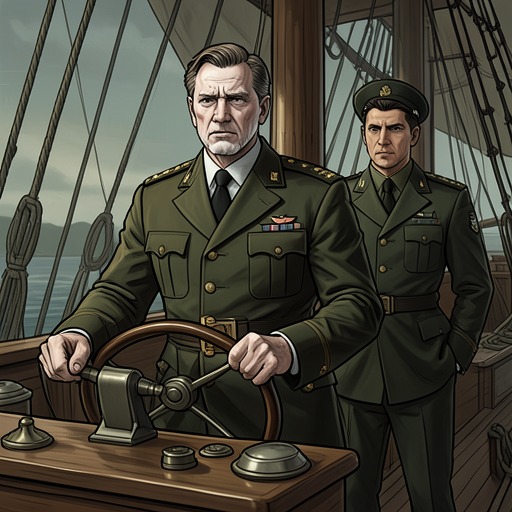
The Good Shepherd“A little sleep, a little slumber, a little folding of the hands to sleep” is a biblical phrase that gathers the tension between vigilance and bodily exhaustion in George Krause’s command. First invoked as a warning against lapsing into sleep at his post, it returns when he can no longer manage even a word before making his way to his cabin. Between those appearances, Krause’s decisions about rest show that sleep is not simply a personal failing: it is also a condition of keeping a warship and its crew ready for action.
The Phrase as Warning
At his post, Krause nearly falls from his stool after sleep creeps up on him. The lapse shocks him: he has been awake through prolonged strain, and he judges himself by the example a captain must set. He stands to keep awake, enduring painful feet rather than go to his cabin for slippers. In this moment, the phrase’s image of folding the hands marks the surrender of vigilance that Krause fears; his response is to treat discomfort as a guard against further drowsiness.
The passage reinforces that warning with another biblical-sounding admonition, “Drowsiness shall clothe a man with rags.” Krause reads his near-sleep not as an abstract weakness but as evidence of how quietly fatigue can defeat intention. The contrast is sharp: his conscious resolve insists that it will not happen again, while the body has already demonstrated that resolve alone cannot guarantee alertness.
Rest as a Command Decision
Krause’s concern extends beyond his own watchfulness. Because Keeling has been in contact with the enemy throughout the day, he decides there will be no routine call to general quarters before dawn; unless an emergency arises, the watch below will receive a full four hours of rest. The decision recognizes that summoning the crew without operational need would consume sleep without improving readiness.
That judgment responds to the ship’s particular pressures. New weapons and instruments have brought additional personnel into already crowded living quarters, while the shortage of trained ratings means the crew cannot furnish three watches for Condition Two. Krause has divided the company into four sections and established a watch-and-watch routine, seeking to avoid adding further burdens. Most officers are working four hours on and eight off, but he also wants to spare them an unnecessary alarm. The phrase therefore resonates beyond individual self-discipline: sleep is a scarce resource shaped by staffing, equipment, and the demands of maintaining a state of readiness.
Return at the Limit of Endurance
The phrase returns after Krause has finished his immediate work. Charlie Cole watches him closely, but Krause has not the strength to exchange a word; the biblical words pass through his mind as he makes his way blindly to the cabin. He fumbles with the hood that has long hung unbuttoned around his face and cannot manage the buttons of his sheepskin coat. Wanting sleep, he drops to his knees beside the bunk and puts his hands before his face.
The recurrence changes the phrase’s force. Earlier, sleep is an enemy Krause means to resist; at the close, it is the need his body can no longer postpone. The image of folded hands thus marks both the danger of letting down one’s guard and the limit of command over the self. His concern for the crew’s rest and his own collapse belong to the same reality: vigilance has to be sustained by human bodies, and those bodies cannot remain alert indefinitely.